Why I Stopped Pasting API Keys Into Random Online Tools (And Built My Own Developer Toolkit)
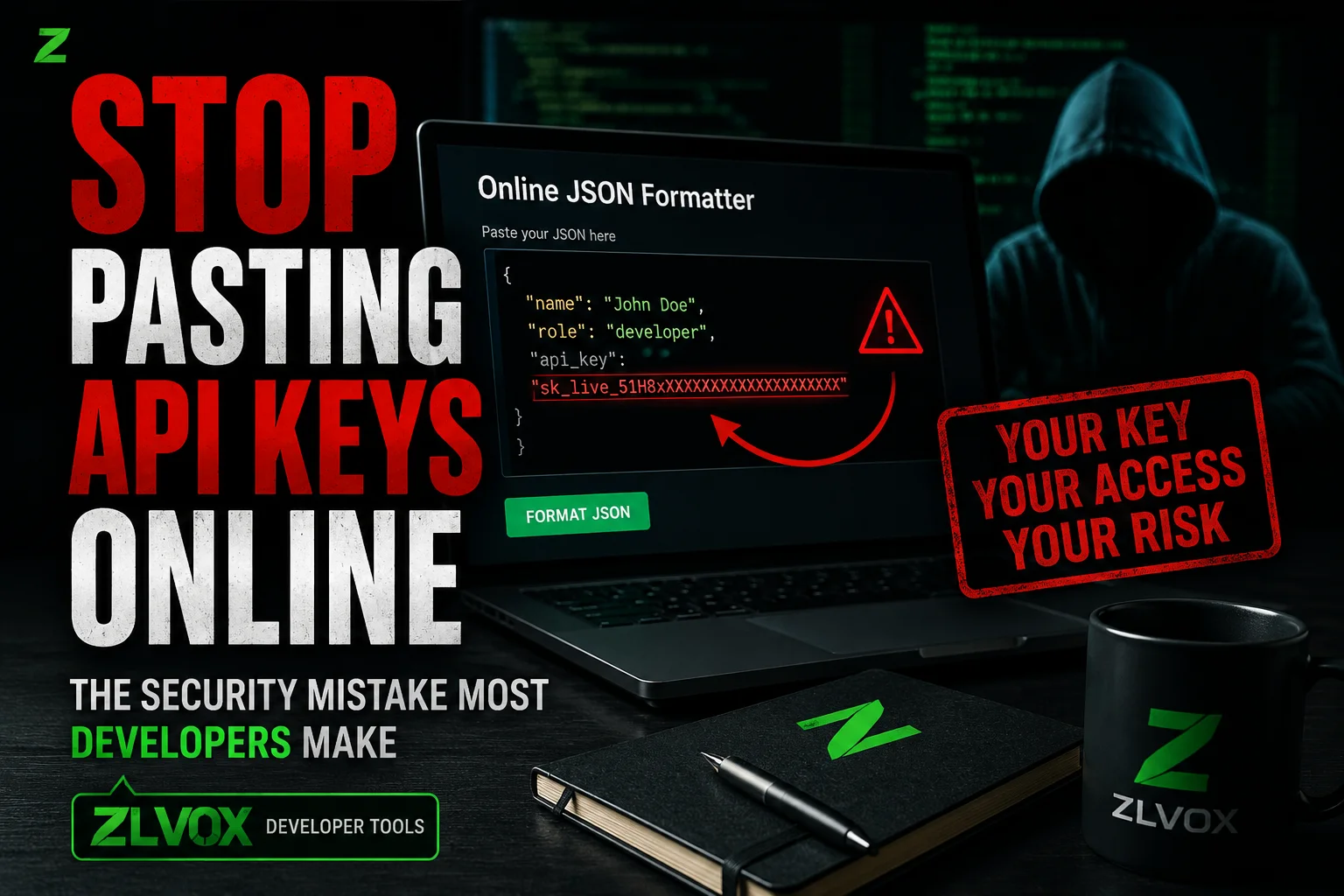
Hey devs, let's be real — we've all been there. You need to format some JSON, test an API, decode a token, validate data, or troubleshoot a response. So you Google it, open the first online tool you find, paste your information, get the result, and move on.
I used to do exactly the same thing.
But one day, I stopped and asked myself a simple question:
Why am I trusting sensitive API keys, access tokens, credentials, and developer data to websites I know absolutely nothing about?
That question completely changed the way I think about online developer tools and eventually led me to build my own developer toolkit: ZLVOX.
The Hidden Risks of Free Online Developer Tools
As developers, we spend countless hours securing our applications. We use HTTPS, authentication systems, encryption, role-based access controls, firewalls, and security best practices to protect users and infrastructure.
Yet many of us casually paste sensitive information into random online tools without giving it a second thought.
Think about the types of information developers commonly submit to web-based utilities:
- API Keys
- Access Tokens
- JWT Tokens
- Webhook Secrets
- Database Connection Strings
- Cloud Credentials
- Customer Information
- Internal API Responses
- Configuration Files
The reality is simple: once you click submit, you often have no idea what happens to that information behind the scenes.
What's Happening Behind the Scenes?
Most online developer tools are not malicious. In fact, many are built by talented developers trying to solve real problems. The issue isn't necessarily bad intentions — it's a lack of transparency.
Here are a few things that may happen when you use an online tool:
Request Logging
Many web applications log incoming requests for debugging, analytics, and monitoring purposes. If your API key or access token is included in those requests, it may become part of server logs.
Third-Party Monitoring Services
Modern websites often rely on analytics and monitoring platforms. Depending on implementation, sensitive information may be unintentionally exposed to external services.
Data Retention
How long does the platform keep your submitted information? A few seconds? A few days? Forever? Most users never know because this information is rarely transparent.
Shared Infrastructure
Many smaller tools run on shared hosting environments or budget infrastructure. Security practices can vary significantly depending on the experience and priorities of the platform owner.
The Trust Problem
The issue isn't that every online tool is unsafe.
The issue is blind trust.
When you paste an API key into an unfamiliar website, you're effectively granting access to systems, services, and potentially business-critical resources.
That's a significant amount of trust to place in a platform you've never audited and know very little about.
Every API key represents permissions, access, and potentially real money. Treat it with the same level of care as a production password.
Why I Built My Own Developer Tools
After thinking about these concerns for a long time, I decided to stop depending on random websites for everyday development tasks.
Instead, I started building simple utilities tailored to my own workflow.
Initially, they were basic tools designed to solve common developer problems quickly and efficiently.
Over time, the collection continued to grow and eventually evolved into a larger project called ZLVOX.
Today, ZLVOX includes privacy-focused developer utilities such as:
Each tool is built around a simple idea: help developers work faster while respecting their privacy and keeping unnecessary complexity out of the workflow.
Developer Experience Matters
As a full-stack developer working with APIs, databases, authentication systems, cloud services, and automation tools every day, I've used hundreds of online utilities throughout my career.
That experience taught me something important:
Most developers don't need more features. They need faster, cleaner, and more trustworthy tools.
Too many utility websites today are overloaded with aggressive advertisements, forced registrations, intrusive popups, unnecessary tracking, and bloated interfaces.
The result is a frustrating experience that slows developers down instead of helping them.
The Philosophy Behind ZLVOX
Developer tools should solve problems, not collect data.
That single principle became the foundation of ZLVOX.
I wanted to create a platform focused on:
- Speed
- Simplicity
- Privacy
- Developer Productivity
- Transparency
A place where developers can quickly access useful tools and get back to building products instead of fighting complicated interfaces.
Why Privacy Matters More Than Ever
Modern software development relies heavily on APIs, AI platforms, cloud services, third-party integrations, automation systems, and external infrastructure.
As a result, developers handle more sensitive information than ever before.
A single exposed API key can potentially lead to:
- Unauthorized API Usage
- Unexpected Billing Charges
- Data Exposure
- Service Disruptions
- Security Incidents
That's why security should extend beyond production applications and include the tools we use throughout our daily development workflow.
Lessons I Learned
Building my own developer toolkit taught me several valuable lessons:
- Convenience should never replace security.
- Developer experience matters.
- Privacy builds long-term trust.
- Simple tools are often more effective than bloated platforms.
- Building a solution is often more productive than complaining about a problem.
The Future of Developer Tools
I believe the next generation of developer tools will focus heavily on:
- Privacy-First Design
- Client-Side Processing
- Minimal Data Collection
- Faster Performance
- Better Transparency
- AI-Assisted Workflows
Developers are becoming increasingly aware of how their information is handled, and that's a positive trend for the entire software industry.
Frequently Asked Questions
Is it safe to paste API keys into online tools?
Developers should avoid pasting production API keys into unknown online tools unless they fully trust the platform and understand how data is processed, transmitted, and stored.
Why are API keys considered sensitive?
API keys can grant access to services, customer data, cloud infrastructure, and billable resources. If exposed, they may result in unauthorized usage, security incidents, or unexpected costs.
What are the risks of random online developer tools?
Potential risks include request logging, credential exposure, third-party monitoring, data retention, and insufficient security controls.
What is a safer alternative?
Privacy-focused developer tools, self-hosted solutions, local applications, and client-side processing utilities generally reduce unnecessary data exposure.
Why did I build ZLVOX?
I built ZLVOX because I wanted developer tools that prioritize privacy, speed, simplicity, and productivity without unnecessary data collection or distractions.
Final Thoughts
The next time you're about to paste an API key, access token, webhook secret, database credential, or sensitive payload into a random online tool, take a moment and ask yourself:
Do I truly trust this platform with access to my systems, my users, and my data?
If the answer isn't a confident yes, it may be worth looking for a safer alternative or building one yourself.
That's exactly what led me to create ZLVOX.
Every API key represents access, permissions, and potentially real money. Treat it like a password. If you wouldn't paste your production password into a random website, you probably shouldn't paste your API key either.