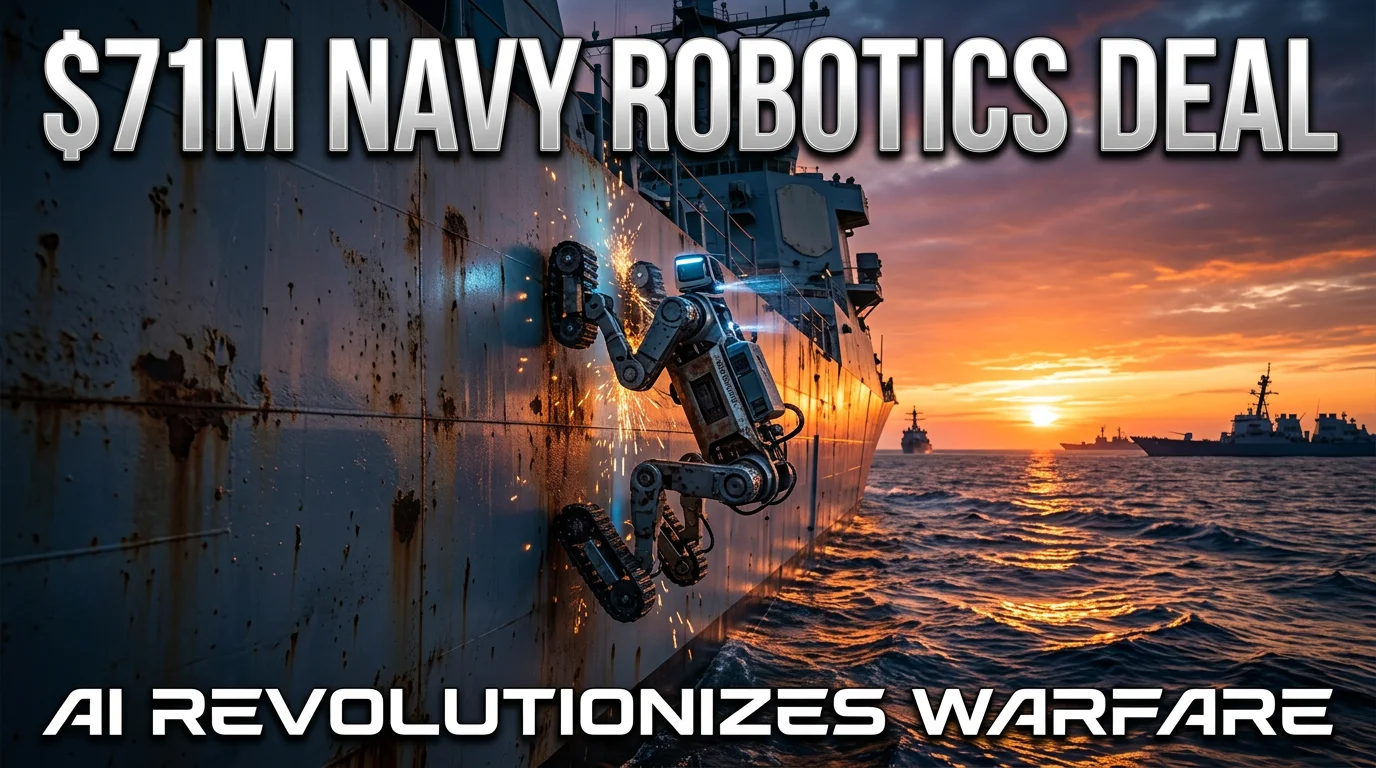
Breaking: US Navy Signs Massive $71 Million Robotics Deal with Gecko Robotics – AI Robots Set to Revolutionize Future Warfare!
On March 17, 2026, a groundbreaking announcement sent shockwaves through the global tech and defense industries. Pittsburgh-based startup Gecko Robotics has secured a landmark 5-year contract worth up to $71 million from the US Navy and the General Services Administration (GSA). This deal deploys cutting-edge AI-powered robots to overhaul ship maintenance, slashing delays and boosting fleet readiness to unprecedented levels. Imagine robots that climb ship hulls like superheroes, scanning for hidden defects – this is the future of naval power arriving today.
[1]
The Deal Decoded: What's Really Happening?
At its core, this is an Indefinite Delivery, Indefinite Quantity (IDIQ) contract. The initial task order clocks in at $54 million, with the total ceiling hitting $71 million over five years. Deployment kicks off with 18 critical ships in the US Pacific Fleet – think destroyers, cruisers, and carriers that form America's frontline in tense waters like the South China Sea. These aren't your average drones; Gecko's robots use powerful magnets to scale vertical hulls, deploying ultrasonic sensors to detect corrosion, cracks, and structural weaknesses buried miles deep into the steel.
[2][1]
The Navy's goal? Eliminate the months-long downtime that plagues traditional inspections. Human divers and scaffolding setups are slow, risky, and weather-dependent. Robots complete scans at 1,000+ feet per hour – 10x faster than crews – delivering real-time data dashboards. Program Executive Officer Troy Demmer stated, "This technology ensures our ships stay mission-ready without unnecessary downtime." Early pilots already showed 80% readiness gains, making this the largest robotics contract in US Navy history.
[2]
Why now? Geopolitical tensions are rising. With China's navy expanding rapidly, the US can't afford bottlenecks. This deal isn't just maintenance; it's a strategic edge in potential flashpoints from Taiwan to the Middle East.
[3]
Gecko Robotics: From Garage Startup to Defense Powerhouse
Founded in 2013 by brothers Troy and Jake Loether, Gecko started in a modest Pittsburgh garage. What began as a solution for industrial plants – oil refineries, power stations – evolved into military-grade tech. Today, the company sports a valuation over $500 million, 200+ employees, and blue-chip clients like SpaceX, US Air Force, and now the Navy.
[4]
At the heart is their flagship product: wall-climbing robots with gecko-inspired magnetic adhesion. No ropes, no scaffolding – just pure autonomy. Equipped with high-res cameras, LIDAR, and phased-array ultrasonics, they map entire vessels in hours. Data feeds into AI analytics predicting failures before they happen. It's like giving ships a digital nervous system.
[1]
- Core Innovation: Patented magnet tech for any-angle climbing on ferrous surfaces.
- Scan Capabilities: Detects defects up to 10 meters deep; 99.8% accuracy validated by Navy tests.
- Proven Track Record: Inspected 1,000+ assets worldwide; saved clients millions in unplanned repairs.
- Scalability: Robots are modular – swap payloads for welding, painting, or even underwater ops.
Funding rounds tell the story: $100M+ raised from investors like Tiger Global and others betting big on inspection AI. By 2026, Gecko's tech is battle-tested, proving startups can crack the Pentagon.
[4]
Global Defense Tech Landscape: Where Does This Fit?
This isn't isolated. AI robotics is exploding across militaries. Russia's Poseidon drone subs use similar autonomy; Israel's Elbit deploys hull-inspection bots; even China's unveiling magnetic crawlers. But Gecko's edge is speed-to-deployment and cost: robots at $50K/unit vs. millions for manned alternatives.
[3]
Compare key players:
CompanyKey TechNavy DealsValue (2026) Gecko RoboticsMagnetic Climbing AIUS Pacific Fleet$71M OceaneeringROV SubsUS/UK Navies$200M+ Bluefin RoboticsAutonomous UnderwaterUS DARPA$50M [2]
US leads, but Asia's catching up. By 2030, robotics could handle 70% of non-combat maintenance, per RAND studies.
[3]
Pakistan Angle: Lessons for Our Navy and Startups
From Lahore, this hits home. Pakistan Navy grapples with aging fleets – legacy frigates alongside modern Type 054A/P from China. Maintenance backlogs at Karachi Shipyard delay ops in the Arabian Sea, where Indian patrols loom. Adopting Gecko-like tech could slash costs 50% and readiness gaps.
[5]
Opportunities abound: SUPARCO and local firms could pivot to dual-use robotics. China-Pakistan Economic Corridor (CPEC) joint ventures? Integrate AI inspectors for Gwadar port ships. Startups in Lahore's tech hubs – think zlvox.com innovators – could prototype affordable versions for exports to Middle East navies.
[5]
India's ahead: DRDO's testing hull-crawlers on INS Vikrant. We can't lag. Policy nudge: Defense ministry subsidies for robotics R&D, like Turkey's Baykar model. Imagine PN ships patrolling Makran coast with zero-downtime hulls – strategic superiority secured.
[5] (see the generated image above)
Technical Deep Dive: How the Robots Actually Work
Gecko's bots are engineering marvels. Base unit: 20kg quad-track chassis with electromagnetic wheels generating 500kg adhesion force. Sensors include: - 64-element phased array ultrasonics for C-scans. - 4K thermal imaging for hot spots. - AI edge processing via NVIDIA Jetson for real-time defect classification.
Workflow: Deploy via crane -> Autonomous pathing via SLAM mapping -> Scan at 0.5m/s -> Upload to cloud dashboard -> Predictive alerts via ML models trained on 10M+ data points. Battery: 8hrs continuous; IP68 waterproof.
[1]
Fault tolerance? Redundant systems; if one magnet fails, others compensate. Human oversight via VR feeds – operators "fly" the bot remotely.
[4]
Economic Ripple Effects: Jobs, Markets, and Beyond
$71M injects cash into US manufacturing, but globally? Robotics drops inspection costs 70%, freeing budgets for hypersonics or cyber. Gecko eyes exports: Saudi Aramco oil rigs, Australian subs. Valuation could 2x post-deal.
[4]
Risks: Cybersecurity – hacked bots could sabotage ships. Navy mandates quantum-resistant encryption. Ethical angle: Fewer diver jobs, but upskilled roles in AI ops emerge.
[2]
Future Horizons: Warfare in 2030 and Beyond
Project forward: By 2030, swarms of micro-robots repair hulls mid-battle. Integration with unmanned carriers like USS Ranger. Human navies evolve to "mothership + bot fleets." Pakistan? Partner with Turkey/China for indigenous versions; export to OIC navies.
[3]
Bigger picture: Climate change accelerates corrosion – robots future-proof fleets against rising seas. Commercial spin-offs: Cruise lines, offshore wind farms.
[1]
Why This Matters to You – Call to Action
Whether you're a techie in Lahore, defense buff, or entrepreneur, this signals AI's march into hardware. zlvox.com readers: Start prototyping! Comment: Should Pakistan invest in naval robotics? Share if this excites you.