TensorWave Raises $350M at $1.55B Valuation: What It Means for AMD and the AI Industry
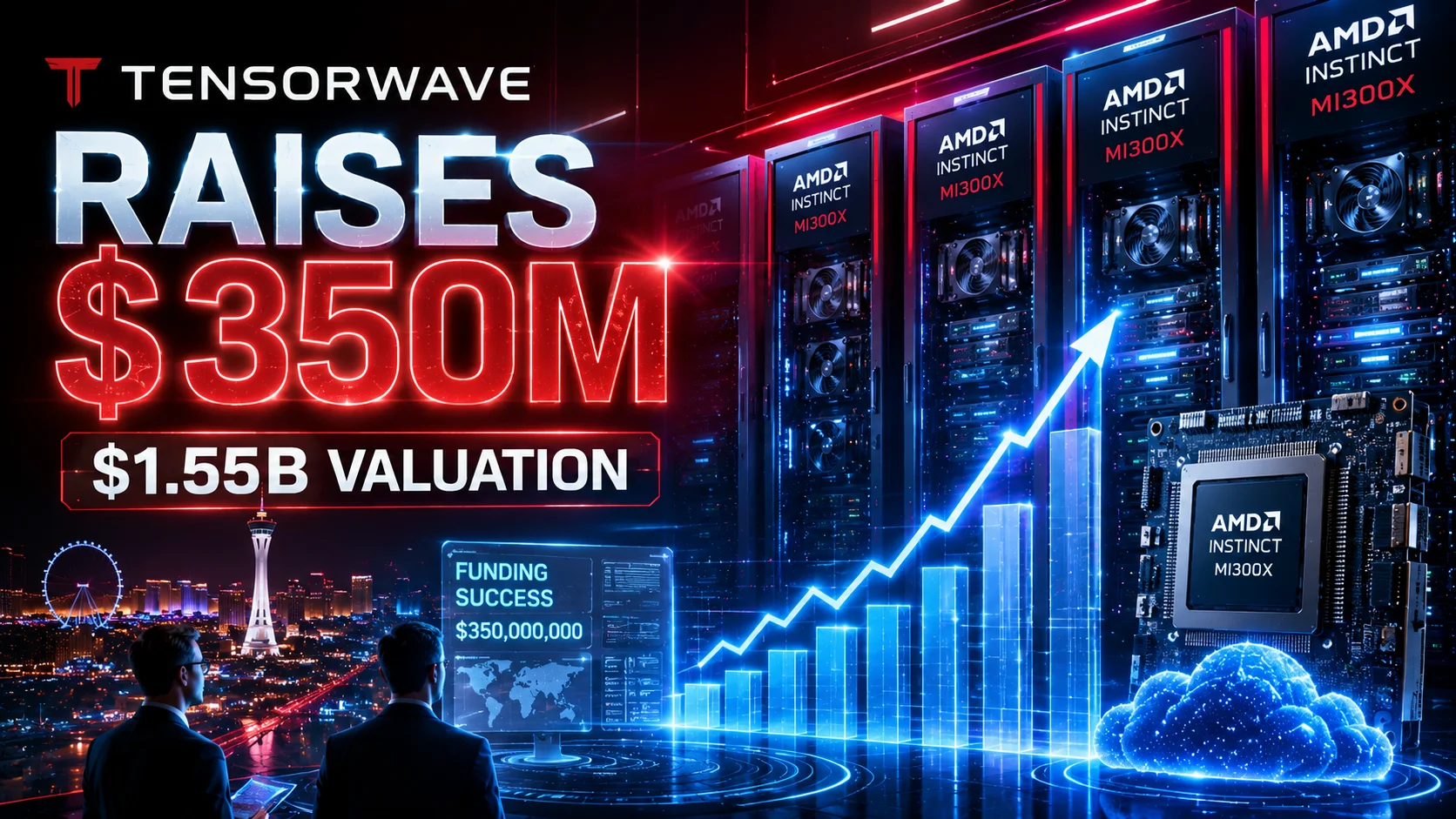
The AI infrastructure market just got a serious jolt. TensorWave, a Las Vegas-based cloud computing startup that has built its entire business around AMD hardware, has closed a $350 million Series B funding round at a $1.55 billion valuation. The round was co-led by AMD itself and the hedge fund Magnetar Capital, with additional participation from firms including Maverick Silicon, Nexus Venture Partners, and Western Frontier.
What makes this story bigger than a typical funding announcement is the math behind it. A year ago, TensorWave was valued at roughly $400 million. Today it sits at $1.55 billion — nearly a 4x jump in twelve months. That kind of valuation surge doesn't happen in a vacuum, and it tells us something important about where AMD, AI cloud providers, and enterprise buyers think the market is heading in 2026.
This article breaks down who TensorWave actually is, why AMD chose to back a company that exists almost entirely to compete with NVIDIA-dominated clouds, and what this funding round signals for the broader AI infrastructure landscape.
Who Is TensorWave?
TensorWave is a cloud computing company founded in 2023 and based in Las Vegas. Its co-founder and CEO, Darrick Horton, built the company around a single contrarian premise: refuse to use NVIDIA hardware entirely, and build an AI cloud exclusively on AMD's Instinct accelerators instead.
That premise has only gotten more relevant as AI compute demand has outpaced supply for the better part of three years. While most "neoclouds" — specialized AI infrastructure providers like CoreWeave and Nebius — built their businesses around securing as many NVIDIA GPUs as possible, TensorWave went the opposite direction.
Key facts about TensorWave heading into this round:
- Founded in 2023, headquartered in Las Vegas
- CEO and co-founder: Darrick Horton, also a co-founder alongside Jeff Tatarchuk and Piotr Tomasik
- Operates three data centers across Pennsylvania, Arizona, and Florida
- Each data center reportedly houses around 10,000 AMD Instinct GPUs, with capacity equivalent to roughly 14 megawatts
- Offers bare-metal servers and managed Kubernetes clusters for AI training and inference
- Built entirely on AMD's ROCm software stack rather than NVIDIA's CUDA
The company has already proven it can handle serious workloads. TensorWave has supported training runs for models exceeding 405 billion parameters using 8-GPU node configurations, each GPU carrying 192GB of VRAM — a scale that puts it firmly in the conversation alongside much larger, NVIDIA-backed cloud providers.
The $350M Series B Round Explained
The headline numbers are straightforward: $350 million raised, $1.55 billion post-money valuation, co-led by AMD and Magnetar Capital. But the structure of this round is what makes it genuinely newsworthy.
This wasn't TensorWave's first major raise. The company previously closed a $100 million Series A round in May 2025, also co-led by AMD and Magnetar, which valued the company at around $400 million. Going from $400 million to $1.55 billion in roughly a year represents one of the steeper valuation climbs in the AI infrastructure space — and it happened during a period when GPU supply constraints and AI demand were both intensifying simultaneously.
A simplified view of the funding trajectory:
- Series A (May 2025): $100 million raised, valuation around $400 million, led by AMD and Magnetar Capital
- Series B (2026): $350 million raised, valuation around $1.55 billion, led by AMD and Magnetar Capital, with additional participation from Maverick Silicon, Nexus Venture Partners, and Western Frontier
According to CEO Darrick Horton, the new capital will primarily go toward two things: expanding data center capacity and acquiring more AMD Instinct accelerators. In other words, this is a scaling round, not a survival round — TensorWave is using the money to grow into demand it says already exists, not to plug holes in its business model.
Why AMD Backed TensorWave
The most important detail in this entire story is who is writing the checks. AMD is not just TensorWave's chip supplier — it's now also a lead investor in the company, for the second round in a row.
This is a deliberate strategy, and it's one NVIDIA itself has used extensively. NVIDIA has poured tens of billions of dollars into AI equity investments across the industry, including stakes in companies like Nebius, effectively using its balance sheet to create demand for its own hardware while also gaining financial upside from the AI boom it helped create.
AMD backing TensorWave mirrors that exact playbook, just from the other side of the GPU rivalry:
- AMD gets a guaranteed, large-scale buyer for its Instinct MI300X, MI325X, and upcoming MI355X and MI455X accelerators
- AMD gets a real-world showcase proving its hardware can run frontier-scale AI workloads outside of AMD's own labs
- AMD gets equity upside in a company whose valuation is directly tied to AMD chip adoption
- AMD gets a partner actively helping mature the ROCm software ecosystem through real production deployments
That last point matters more than it might seem. For years, AMD's biggest weakness in AI wasn't its silicon — it was software. ROCm has historically lagged behind CUDA in tooling, documentation, and out-of-the-box performance. TensorWave has worked directly with AMD to improve ROCm to the point where, according to Horton, it's now "pretty much plug-and-play" for many workloads. A funded, motivated customer running AMD chips at scale is exactly the kind of feedback loop AMD needs to close that gap faster.
TensorWave's Valuation Surge: From Startup to Unicorn Contender
Going from a $400 million valuation to $1.55 billion in about a year places TensorWave firmly in "unicorn contender" territory, and the timing isn't coincidental. Several forces converged at once.
First, NVIDIA's premium hardware — particularly the new Blackwell-generation B200 — has been heavily supply-constrained, with backlogs estimated in the millions of units as cloud providers and hyperscalers compete for allocation. When the dominant supplier can't keep up with demand, customers start looking for alternatives, and that search benefits whoever has scaled capacity ready to go.
Second, AMD's Instinct MI300X has matured from "interesting alternative on paper" to "viable production hardware" over the past two years. Independent benchmarking has shown the MI300X holding clear advantages in memory capacity and bandwidth — it ships with 192GB of HBM3 versus the H100's 80GB, and roughly 5.3 TB/s of bandwidth versus the H100's 3.35 TB/s. For memory-bound inference workloads, especially serving large language models with long context windows, those numbers translate into real cost and performance advantages.
Third, and perhaps most importantly, AMD's repeated willingness to co-lead funding rounds signals long-term commitment rather than a one-off marketing partnership. Investors reading this round don't just see "AMD customer" — they see "AMD's flagship proof point for its entire AI infrastructure strategy."
How TensorWave Uses AMD Hardware Instead of Relying on NVIDIA
TensorWave's infrastructure stack is built end-to-end around AMD technology, which is unusual even among AMD-friendly providers that typically run mixed fleets.
The core building blocks include:
- AMD Instinct MI300X — the current workhorse, offering 192GB of HBM3 memory per GPU, ideal for large-context inference and large model training
- AMD Instinct MI325X — an upgraded variant with enhanced memory capacity and bandwidth for large-scale training and inference
- AMD Instinct MI355X — built on CDNA 4 architecture, optimized for inference throughput and efficiency using advanced low-precision data formats
- ROCm software stack — AMD's open-source alternative to CUDA, used across TensorWave's entire platform
- Direct liquid cooling — used to manage the thermal demands of dense GPU clusters while improving energy efficiency
- Weka-powered high-speed storage — supporting data-intensive AI training pipelines
For developers, this means workloads need to be compatible with ROCm rather than CUDA. Two years ago, that would have been a dealbreaker for most production teams. Today, frameworks like PyTorch and vLLM have meaningfully improved ROCm support, and TensorWave's own engineering work with AMD has reportedly closed much of the remaining gap for common inference use cases — though dense, large-scale training workloads still tend to favor NVIDIA's more mature distributed training tooling.
What This Means for the AI Cloud Market
The AI cloud market — sometimes called the "neocloud" sector — has been dominated by NVIDIA-powered providers like CoreWeave, Lambda, and Nebius, all of which have signed multibillion-dollar deals built almost entirely on NVIDIA GPUs. TensorWave's rise represents the first credible AMD-only counterweight at meaningful scale.
This matters for a few reasons:
- It introduces real price competition. AMD Instinct MI300X instances have been available at price points often below comparable NVIDIA H100 instances, giving cost-sensitive teams a genuine alternative.
- It reduces single-vendor risk for customers. Enterprises building long-term AI infrastructure strategies are increasingly wary of being locked into one chip ecosystem, especially given how volatile GPU availability and pricing have been.
- It validates AMD as a production-grade option. A $1.55 billion valuation backed by AMD's own balance sheet sends a strong signal to other cloud providers that AMD-based infrastructure is no longer experimental.
- It pressures NVIDIA-aligned providers on pricing and supply terms. Even if most customers stay on NVIDIA, having a credible alternative changes negotiating dynamics across the entire market.
AMD vs NVIDIA: A Growing Battle in AI Infrastructure
It's tempting to frame this purely as "AMD vs NVIDIA," and in many ways, that framing is accurate — TensorWave's CEO has been explicit that the company exists specifically because he believes NVIDIA controls too much of the AI infrastructure market.
But the more accurate framing is that this is a battle over the entire AI compute supply chain, and TensorWave is one visible front in a much larger conflict. NVIDIA's dominance stems from three layers working together: best-in-class silicon, the CUDA software ecosystem, and deep relationships across hyperscalers and cloud providers. AMD's challenge has never really been about matching NVIDIA chip-for-chip on a spec sheet — on paper, the MI300X already beats the H100 in memory and bandwidth. The challenge has been replicating the other two layers.
TensorWave is essentially AMD's attempt to build all three layers simultaneously, in public, with a funded and motivated operator running the show. Here's how the competitive positioning breaks down:
- Hardware: NVIDIA-centric clouds (CoreWeave, Lambda, Nebius) run on H100, H200, and B200. TensorWave runs on MI300X, MI325X, and MI355X.
- Software ecosystem: NVIDIA-centric clouds rely on CUDA, mature and dominant. TensorWave runs on ROCm, open-source and rapidly improving.
- Strategic backer: NVIDIA has made equity investments across the neocloud sector. AMD is a direct co-lead investor in TensorWave.
- Primary advantage: NVIDIA-centric clouds offer software maturity and the broadest tooling support. TensorWave offers larger memory capacity, higher bandwidth, and more competitive pricing.
- Primary constraint: NVIDIA-centric clouds face GPU supply shortages, especially for Blackwell. TensorWave has a smaller global footprint and a steeper ROCm learning curve for some teams.
Why AI Startups Are Looking Beyond NVIDIA
Three converging pressures are pushing AI startups to at least evaluate alternatives to NVIDIA-only infrastructure.
The first is availability. Premium NVIDIA hardware, particularly the Blackwell B200, has faced backlogs reportedly in the millions of units, with hyperscalers receiving priority allocation. Smaller startups often find themselves at the back of the line.
The second is cost. AMD Instinct MI300X instances have frequently been priced below comparable H100 configurations across multiple cloud providers, and for memory-bound inference workloads — think serving a 70-billion-parameter model with a long context window — the MI300X's larger VRAM pool can reduce the number of GPUs needed per deployment, compounding the savings.
The third is strategic risk management. A startup building its entire inference pipeline around CUDA-specific optimizations is making a long-term bet on a single vendor's pricing and availability. As AMD's software ecosystem matures, more teams are at least architecting their stacks to be portable across both CUDA and ROCm, even if they primarily run on one today.
Realistic examples of where this plays out:
- A startup serving a customer-support chatbot built on a fine-tuned 70B parameter open-weight model, where inference cost per million tokens directly affects unit economics
- A research lab training domain-specific models in the 7B–34B range, where training time differences between AMD and NVIDIA have narrowed considerably
- An enterprise running retrieval-augmented generation (RAG) pipelines with very large context windows, where memory bandwidth and capacity matter more than raw compute density
Impact on Enterprises and AI Developers
For enterprises evaluating AI infrastructure in 2026, TensorWave's emergence adds a genuine third option to what was previously a two-choice decision: build on NVIDIA, or wait for NVIDIA.
For developers, the practical impact depends heavily on workload type. Teams running inference-heavy applications — chatbots, document processing, RAG systems, agentic workflows — are best positioned to benefit from AMD's memory advantages with relatively manageable migration effort, since inference frameworks like vLLM now have solid ROCm support.
Teams running large-scale distributed pre-training, however, should weigh the tradeoffs more carefully. NVIDIA's NVLink interconnect still provides scaling advantages for tightly coupled multi-GPU training that AMD's Infinity Fabric hasn't fully matched, particularly at very large cluster sizes.
For procurement and finance teams, the bigger story might simply be optionality. Even organizations that ultimately choose to stay on NVIDIA infrastructure benefit from a market where alternatives exist, since it tends to moderate pricing and improve service terms across the board.
Risks and Challenges for TensorWave
A $1.55 billion valuation comes with high expectations, and TensorWave faces real challenges on the path to justifying it.
The most obvious risk is software maturity. While ROCm has improved significantly, it still trails CUDA in terms of out-of-the-box performance tuning, third-party library support, and the sheer volume of community resources, tutorials, and pre-optimized model configurations available to developers.
The second risk is scale. TensorWave's three data centers and roughly 10,000 GPUs are substantial for a three-year-old company, but they're modest compared to the footprint of NVIDIA-aligned hyperscalers and neoclouds that have been building out capacity for years with significantly larger capital bases.
The third risk is broader market dynamics. AI infrastructure buildouts across the industry are largely debt-and-equity-fueled bets on AI demand continuing to grow at its current trajectory. If that demand growth slows, every player in this space — TensorWave included — faces pressure on utilization rates and pricing power.
Finally, there's the dependency question. AMD being both TensorWave's primary supplier and a lead investor creates alignment, but it also means TensorWave's fortunes are tightly coupled to AMD's own execution on chip roadmaps, supply, and pricing.
Expert Analysis: Is TensorWave the Next Major AI Infrastructure Player?
The honest answer is: it's positioned to become a significant niche player rather than a direct NVIDIA-scale competitor in the near term — and that's not a knock on the company.
TensorWave doesn't need to displace NVIDIA to be a major success. It needs to capture a meaningful share of the growing pool of AI workloads where AMD's memory and bandwidth advantages translate into real cost savings, and where ROCm's maturity has crossed the threshold from "experimental" to "production-ready." Large-context inference, retrieval-heavy applications, and cost-sensitive fine-tuning workloads all fit that profile increasingly well in 2026.
What makes TensorWave different from other AMD-curious cloud providers is the depth of its relationship with AMD. This isn't a provider that happens to offer some AMD instances alongside a primarily NVIDIA fleet — it's AMD's most visible bet on proving its AI infrastructure stack can compete at scale, backed by AMD's own capital twice in a row.
If TensorWave continues executing — expanding data center capacity, deepening ROCm optimization work, and maintaining its price advantage — it's reasonable to expect this $1.55 billion valuation to look conservative within another funding cycle. If software maturity gaps or scaling challenges slow it down, the valuation could prove to have run ahead of the fundamentals. Either way, TensorWave is now impossible to ignore in any serious conversation about AI infrastructure.
FAQ Section
How much money did TensorWave raise in its Series B round?
TensorWave raised $350 million in its Series B funding round, co-led by AMD and Magnetar Capital, with additional investors including Maverick Silicon, Nexus Venture Partners, and Western Frontier.
What is TensorWave's current valuation?
TensorWave's Series B round values the company at approximately $1.55 billion, up from roughly $400 million a year earlier — nearly a 4x increase.
Who is the CEO of TensorWave?
Darrick Horton is the co-founder and CEO of TensorWave. He co-founded the company alongside Jeff Tatarchuk and Piotr Tomasik in 2023.
Why did AMD invest in TensorWave?
AMD invested in TensorWave to create a guaranteed customer for its Instinct accelerators, showcase AMD hardware running frontier-scale AI workloads, gain equity upside tied to AMD chip adoption, and accelerate real-world maturity of its ROCm software ecosystem.
What hardware does TensorWave use?
TensorWave runs exclusively on AMD Instinct accelerators, including the MI300X, MI325X, and MI355X, paired with AMD's ROCm software stack rather than NVIDIA's CUDA.
Is TensorWave a competitor to NVIDIA?
TensorWave positions itself as an alternative to NVIDIA-centric AI clouds by building its entire infrastructure on AMD hardware. It isn't a direct NVIDIA competitor in the chip sense, but it competes with NVIDIA-powered cloud providers for AI training and inference customers.
Where are TensorWave's data centers located?
TensorWave operates three data centers in the United States, located in Pennsylvania, Arizona, and Florida, each housing approximately 10,000 AMD Instinct GPUs.
Is AMD hardware cheaper than NVIDIA for AI workloads?
AMD Instinct MI300X instances have generally been priced below comparable NVIDIA H100 instances across several cloud providers, and the MI300X's larger 192GB memory capacity can reduce the number of GPUs needed for memory-bound inference workloads, improving overall cost efficiency.
What will TensorWave do with the new funding?
According to CEO Darrick Horton, the $350 million will primarily fund expanded data center capacity and the acquisition of additional AMD Instinct accelerators to meet growing demand.
Final Conclusion
TensorWave's $350 million Series B at a $1.55 billion valuation is more than a funding milestone — it's a signal that AMD is serious about building a complete, production-grade alternative to NVIDIA's AI infrastructure dominance, and that it's willing to bet its own capital on a single operator to prove it. For AMD, TensorWave is a flagship customer, a software development partner, and an investment all at once. For the broader AI industry, TensorWave's rise gives startups and enterprises a real second option for the first time in years — one with genuine memory and pricing advantages for the right workloads.